
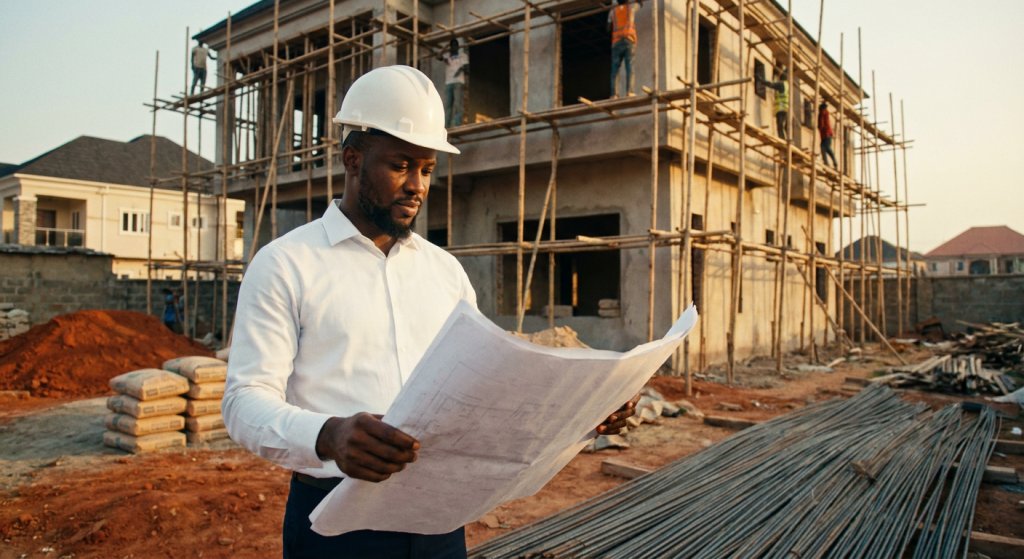
You've done the research. You've saved for years. You've even picked out the floor tiles. Then, six months into your build, the contractor calls with that familiar phrase: "We need to revisit the budget."
For thousands of diaspora Nigerians commissioning home builds from the UK, US, Canada, and beyond, this moment is not a surprise — it is practically a rite of passage. A project quoted at ₦50 million quietly becomes ₦65 million, then ₦75 million, then ₦80 million. By the time the roof goes on, you've spent 40% more than you were told, and you're still not done.
Most people blame land fraud. And whilst land fraud is a genuine concern, the data — and the lived experience of hundreds of Nigerian homebuilders — tells a different story. The single biggest threat to your construction budget is not the land seller. It is an inaccurate, unverified, or deliberately vague Bill of Quantities from your contractor.
What Is a Bill of Quantities — and Why Does Yours Probably Have Holes in It?
A Bill of Quantities (BoQ) is a detailed document that lists every material, labour task, and associated cost required to complete a construction project. In theory, it should give you a precise financial roadmap from foundation to finishing. In practice, for many Nigerian construction projects — particularly those commissioned without professional oversight — it does neither.
The Three Most Common BoQ Failures in Nigeria
1. Omission of Provisional Items
Contractors frequently exclude costs they consider secondary: site clearing, water supply during construction, generator hire, welfare provisions for workers, and waste disposal. These are not minor line items. On a standard 4-bedroom detached build, these provisional costs can account for ₦3–6 million.
2. Underpriced Rates Tied to Fluctuating Material Costs
Nigeria's construction materials market is notoriously volatile. The price of reinforcement steel, cement, and imported fittings can shift 20–30% within a single quarter, driven by exchange rate movements and supply chain disruptions. Contractors who quote using today's rates without building in an escalation clause are setting you up for a shortfall — whether intentionally or not.
3. Scope Creep Enabled by Vague Specifications
When drawings are not fully detailed, contractors price to a minimum and then bill variations for everything else. A BoQ that says "supply and install roof covering" without specifying the type and gauge of the roofing sheet, the pitch, or the insulation layer is an open invitation for disputes and additional charges.
Why Diaspora Nigerians Are Disproportionately Affected
Understanding diaspora Nigeria home construction risks requires appreciating one structural disadvantage: distance. When you are managing your build from London or Houston, you cannot walk the site on a Tuesday afternoon. You cannot cross-check the concrete pour. You cannot verify that the 600 bags of cement that were invoiced were actually delivered.
This information asymmetry is exploited — sometimes deliberately, often through sheer negligence — by contractors who know their client is thousands of miles away. Without an independent professional on the ground, you are essentially auditing a business whose books you cannot see.
The result? Contractor cost overrun in Nigeria is not an anomaly for diaspora clients. It is the default outcome.
How Much Does It Actually Cost to Build in Nigeria Right Now?
For anyone researching how much it costs to build in Nigeria, honest benchmarking is essential. As of 2024–2025, broadly indicative construction costs per square metre for residential builds in major Nigerian cities are as follows:
- Standard quality finish (Lagos, Abuja): ₦250,000 – ₦380,000/m²
- Medium-to-high quality finish: ₦380,000 – ₦600,000/m²
- Premium/luxury finish: ₦600,000 – ₦1,200,000/m² and above
A modest 250m² four-bedroom home to medium-quality finish in Lagos could therefore cost between ₦95 million and ₦150 million — a figure that shocks many diaspora clients who were quoted far less. If you were quoted ₦50 million for that same brief, you were not given a budget; you were given a deposit hook.
Five Practical Steps to Protect Your Budget Before Ground Is Broken
1. Commission an Independent Cost Plan Before You Appoint a Contractor
Before a single contractor sees your drawings, engage a qualified quantity surveyor (QS) to produce an independent cost estimate. This becomes your benchmark. Any contractor whose quote deviates significantly — in either direction — requires explanation.
2. Insist on a Fully Detailed BoQ With Named Specifications
Every material should be named, branded where applicable, and quantified precisely. "Tiles" is not a specification. "600×600mm CDK ceramic floor tiles, Grade 1, supplied and laid with OPC adhesive" is. Vague specifications are where budgets go to die.
3. Build in a Minimum 15% Contingency — and Lock It Away
This is not pessimism; it is professional practice. On Nigerian construction projects, a 15–20% contingency allowance is not excessive — it is prudent, given material price volatility and the likelihood of unforeseen ground conditions. Keep this fund separate and release it only on professional sign-off.
4. Appoint a Resident Project Manager or Clerk of Works
If you cannot be on site, someone credible must be. A professional project manager or clerk of works employed by you — not by your contractor — provides independent oversight, verifies material deliveries, and approves payment valuations. This single appointment can save you multiples of its own cost.
5. Use professional Building Contract
A formal contract with clearly defined payment milestones, variation procedures, and dispute resolution clauses transforms a handshake arrangement into a legally enforceable agreement. Many Nigerian homebuilders sign nothing more than a one-page quote. Do not be one of them.
Why Professional Oversight Changes the Entire Equation
This is precisely why firms like Imprexi ICDL exist. Rather than leaving diaspora clients to navigate contractor relationships alone, Imprexi provides end-to-end project management — from initial design and detailed cost planning through to construction supervision and handover. Every project is anchored by a verified BoQ, independent QS input, and on-the-ground oversight from professionals who are accountable to the client, not the contractor.
The difference between a ₦50 million project that finishes at ₦52 million and one that finishes at ₦80 million is rarely luck. It is process, documentation, and professional accountability.
The Honest Truth About Building a House in Nigeria
Building in Nigeria can be done well. Thousands of beautiful, well-executed homes are completed every year — on budget, on time, and to a standard that their owners are genuinely proud of. But they share a common thread: they were built with proper professional involvement from the outset, not patched together after the first crisis.
If you are serious about building your dream home without the budget horror story, the most valuable Nigeria construction budget tip anyone can give you is this: invest in professional oversight before you invest in cement.
The 5–8% you spend on architecture, quantity surveying, and project management is the only thing standing between your dream home and a decade of financial regret.
Ready to Build the Right Way?
Imprexi ICDL works with diaspora Nigerians at every stage of the home-building journey — from concept design and verified cost planning to full construction supervision. Whether you are at the idea stage or already mid-build and concerned about where your budget is going, the Imprexi team can help you regain control.
📩 Get in touch today and let's protect your investment from the start.
👉 Contact Imprexi at https://imprexi.com/contact